

Altitude/Process
How we workThe process is not paperwork. It is the product.
Altitude runs a renovation the way a well-managed project gets run anywhere else: understand the job, define what is expected, plan the sequence, communicate when conditions change, and finish. The finished bathroom is the part you see. This is the part that decides whether you enjoyed getting it.
Where this comes from
Before renovation, Luke worked in oil and gas service, managing multimillion-dollar accounts. In that world, timing and accountability were not soft skills. They were the whole job. Be on site when you said you would be. Own the problem in front of you. Ask the question rather than guessing. Tell the client the bad news yourself, early.
Those habits came into contracting intact. It is why Altitude is not organized only around craftsmanship. Plenty of people in this valley can set tile. It is organized around a system: a scope, a sequence, mile markers, testing, and change orders. The system is part of what you are buying.
Four things you can hold us to
A scope in writing before work starts. A named point of contact who is on your job. A message at every mile marker. And a change order, in writing, before anything outside the scope gets done.
Before anyone quotes you a number.
A quote written from a phone call is a guess, and a guess is what turns into an argument in week three. So the first two steps happen before there is a price.
The conversation and the walk-through
We come and look. We listen to what you need, ask questions about how you use the space, and inspect what is actually there. The plumbing, the structure we can see, the age and condition of the room. The point of this visit is to get on the same page about the work before a quote exists.
The detailed scope of work
Then you get a written scope: what is included, what is not, what the expected timeline is, and what could change it. It functions as a checklist and as the shared understanding between us. When a question comes up later, this is the document both of us point at.
The mile markers.
Once work begins, these are the points where you hear from us. Not "it's going well." What was done, what was found, what is next, and anything that changed. A photo where a photo explains it faster than a paragraph.
Start and prep for demolition
We protect the surrounding home and the route to the work area, set up containment and dust control, and explain what is going to happen before it happens.
Demolition
The space gets opened. This is when conditions nobody could see become visible: framing, previous repairs, the state of the plumbing, whether the last installation was done properly. Whatever we find, you hear it from us the same day.
Waterproofing and testing
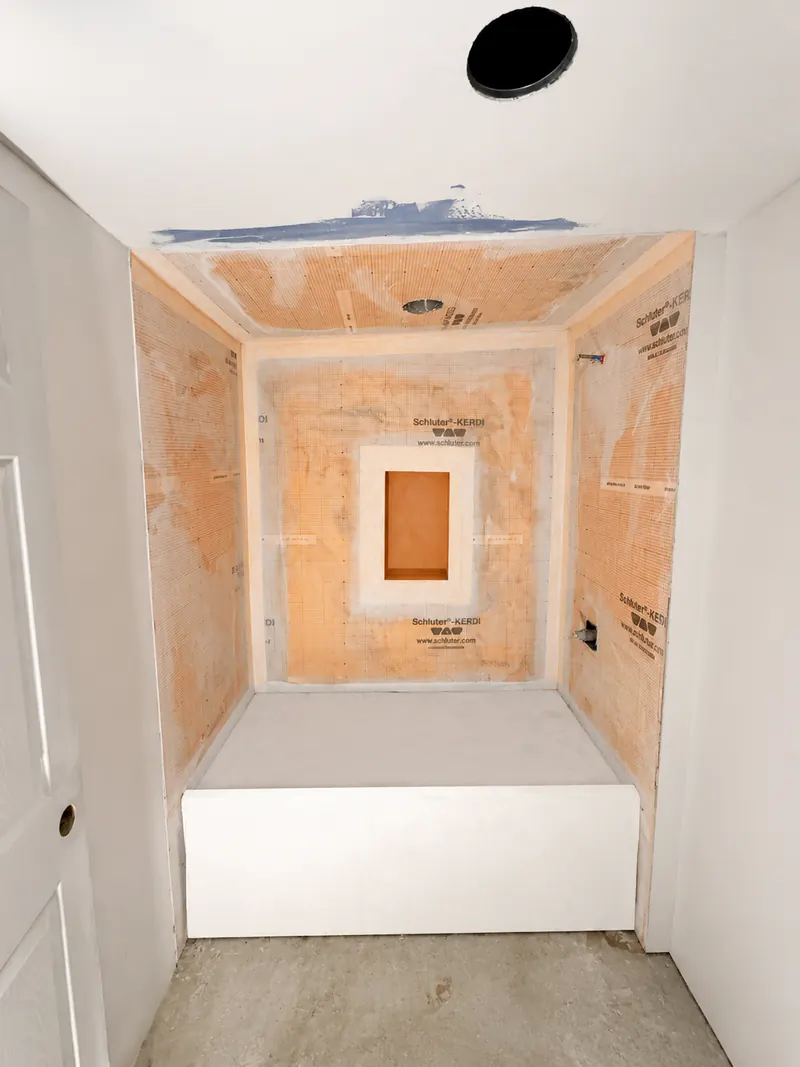
The step that decides whether this bathroom is still sound in fifteen years. We explain the system going in, why it matters, and we test it before anything covers it. If it does not hold, we would far rather know now.
Final design and tile layout
We confirm the visual plan with you before installation: where the pattern starts, how it meets corners, niches, and transitions, and where the cuts land. Changing your mind here is easy and free. Changing it later is neither.
Tile installation
The design gets executed, with the attention to layout and detail that is the difference between a tile job you stop noticing and one you notice every morning.
Grouting and finishing
Grout, sealing, trim, glass, fixtures, and the finish details that make the room feel complete rather than merely done.
Final inspection
We walk the finished work with you, answer questions, and make sure you understand what was done and how to care for it. Then we stay reachable, because we live here.
Change orders, in plain English.
If it was not in the scope, it does not happen until you have said yes to it in writing.
Two things move a project outside its scope. The first is a hidden condition: rot, a cut joist, plumbing that has to move, or moisture behind a wall. The second is a change you decide you want once you can see the room.
Both are handled the same way. We stop, document it, and bring you the whole picture: what it is, what caused it, what the options are, what each one costs, and what it does to the timeline. You decide. Then it goes in writing and becomes part of the record of the project.
This is not us being formal for its own sake. It is the single most common place a renovation relationship goes wrong. Work gets done that nobody agreed to, and it shows up on an invoice at the end. That conversation should happen in week two, standing in the room, not in month three over email.
The six things you should never have to ask for.
If you find yourself chasing us for any of these, we have not done our job.
You will always be told
- What is included in the work, and what is not
- What the timeline is expected to be, and what could affect it
- What is happening at the current mile marker
- Why a specific installation, material, or design decision matters
- When a hidden condition or a change requires a change order
- That quality, communication, and completion are shared responsibilities
What we will not do
- Promise that no surprises will occur on your project
- Start your job, pause it, and move on to someone else’s
- Do work outside the scope and invoice you for it afterward
- Frame accessible work as a compromise on the design
- Describe any project as disposable, rushed, or good enough
- Disappear once the final invoice is paid
About how a project runs.
The practical questions people ask once they realize we are going to be in their house for a few weeks.
Who is actually on my job?
Luke, and the tradespeople Altitude works with regularly. You are not going to meet a salesperson, sign with a company, and then never see that person again.
When a project needs a plumber, an electrician, a structural repair, or an insurance adjuster, we coordinate them rather than handing you a list of numbers.
How often will I hear from you?
At every mile marker, and immediately whenever something changes. Between markers, quick things go by text because that is how people actually communicate, and the organized record of the project lives in our job management software.
What if I am not there while the work happens?
That is common here, and it is fine. We have run full bathroom projects for homeowners who were out of the country, coordinating other trades and handling structural surprises without needing them in the room.
It works because of the scope and the mile markers. You know what was agreed to and you hear what is happening.
Do you take on small jobs?
Yes, and quite a few long relationships started with one. What we will not do is scope a small job as a patch when the honest answer is that it will fail again. We will tell you what a proper repair looks like and let you decide.
What happens after the project is finished?
We walk it with you, and then we remain reachable. Altitude is a local company and Luke is your neighbor. If something comes up a year later, call and you will get an answer.